Off-Grid or Hybrid Solar: Which Suits Your Property?
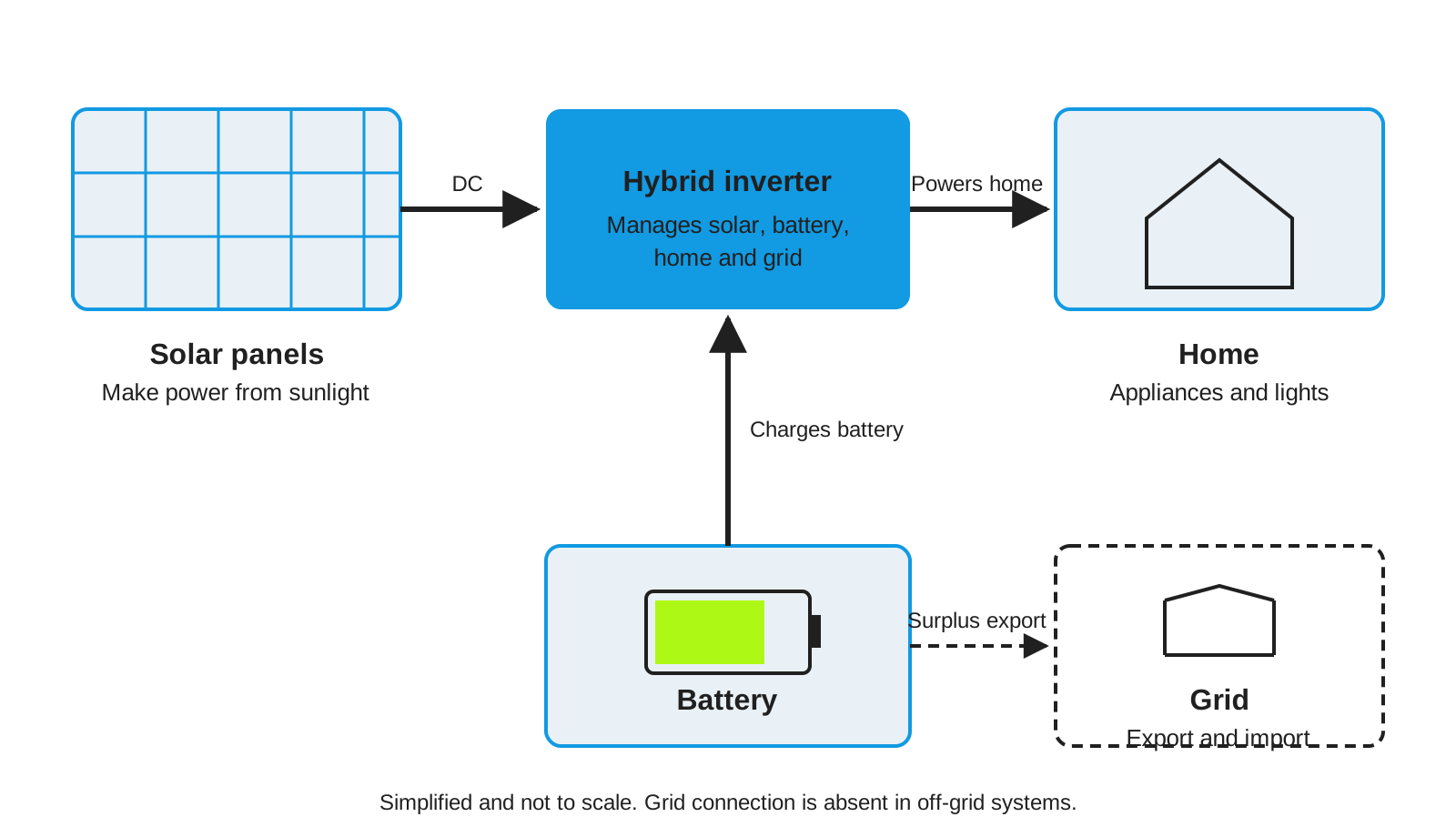
Hybrid solar suits a property that can stay connected to the grid. Off-grid solar suits a property where a grid connection costs too much, or where there is no connection at all. Three things decide the choice: your connection quote, the loads you need to keep running, and whether you want income from exports.
Our off-grid solar systems page compares both options side by side. This post walks through the decision, one question at a time.
Key Points
Hybrid solar keeps the grid connection and adds a battery for the evening.
Off-grid solar has no network connection, so it needs a battery and often a generator to carry the whole property.
Steven Hord's price for a full off-grid system is $60,000 to $120,000, after the rebate.
Steven's price for a new solar and battery system is $22,000 to $45,000, after the rebate.
Off-grid systems earn no feed-in credits, because there is no grid to export to.
The Cheaper Home Batteries Program covers households and businesses, but eligibility for an off-grid battery is still to be confirmed.
What is the difference?
Hybrid solar uses panels, a battery and a hybrid inverter, and keeps the grid connection. It stores daytime solar for the evening. With a backup circuit, it runs the circuits you choose when the grid fails.
Off-grid solar uses panels, a battery and any generator to supply the whole property. It has no network connection and no grid bill.
Standard solar without a battery shuts down in a blackout for safety. A battery and backup circuit change that for the circuits you pick.
Which one suits my property?
Hybrid suits most suburban homes. Off-grid suits a rural property where a network connection costs more than the system, over the same period.
Compare the two paths using written quotes, not estimates. Hybrid keeps the grid as a backup, so the battery can be smaller. Off-grid has no grid behind it, so the battery and generator must carry the whole property.
Our Sigenergy systems can run as a hybrid now and go fully off grid later with the same equipment. That lets you start with the grid and keep the option open.
What does a hybrid system cost?
Prices for a hybrid system, after the rebate, are $16,000 to $30,000 for a battery added to existing solar. A new solar and battery system costs $22,000 to $45,000.
Your price depends on single, dual or three phase power, roof type, storeys, site access, and whether we trench or run overhead mains.
How do I price the grid path?
Ask your network distributor, Energex or Ergon Energy, for an itemised connection quote. Then ask your electrician to price the private works on your side of the connection point.
Compare that total with the off-grid quote over the same period. Do not compare an off-grid quote with a bare connection figure.
What does off-grid cost?
Steven's price for a full off-grid system is $60,000 to $120,000, after the rebate. The price depends on the battery storage you need for cloudy weather, the generator, single, dual or three phase power, roof type, storeys, site access, and whether we trench or run overhead mains.
Prices are current as at October 2026. We give a written quote before any work begins.
What does the switchboard need?
A battery on a full-home backup system needs a switchboard that meets the current standards. Off-grid needs the same work on your switchboard.
Ask for that work in writing with the quote. Our switchboard upgrades and solar guide explains what the work involves.
Can I claim the battery discount?
The federal Cheaper Home Batteries Program offers households and businesses around 30% off batteries from 5 kWh to 100 kWh. The battery must be connected to new or existing solar.
We have not yet confirmed whether an off-grid battery qualifies, so ask us to confirm it in writing before you count the discount.
Does off-grid earn feed-in income?
No. Feed-in credits only arise when you export to the grid. An off-grid system has no grid connection, so it earns none.
A hybrid system can earn feed-in credits under your retailer's plan. Our Queensland solar feed-in tariff guide explains how those rates work.
What happens in a long cloudy spell?
An off-grid system needs enough battery to carry you through poor weather, and many add a generator for the longest runs. A hybrid system draws on the grid when its battery runs low.
Ask your installer how many days of backup the design gives you, and where a generator fits.
Frequently Asked Questions
What is the difference between off-grid and hybrid solar?
Hybrid solar stays connected to the grid and uses a battery for the evening. Off-grid solar has no grid connection, so the battery and generator must carry the whole property.
Which is cheaper, off-grid or hybrid?
It depends on your connection quote. Compare both paths over the same period, using written quotes from your distributor and your installer.
Can a hybrid system become off grid later?
Yes, according to Steven Hord. Our Sigenergy systems can run as a hybrid now and go fully off grid later with the same equipment.
Does an off-grid system earn feed-in credits?
No. An off-grid system has no grid connection to export to, so it earns no feed-in credits.
Ready to see which system suits your property?
Send us your property address and your power bills, and we will talk through which system fits. Get a quote at /get-a-quote, or call us on 1300 153 011.